
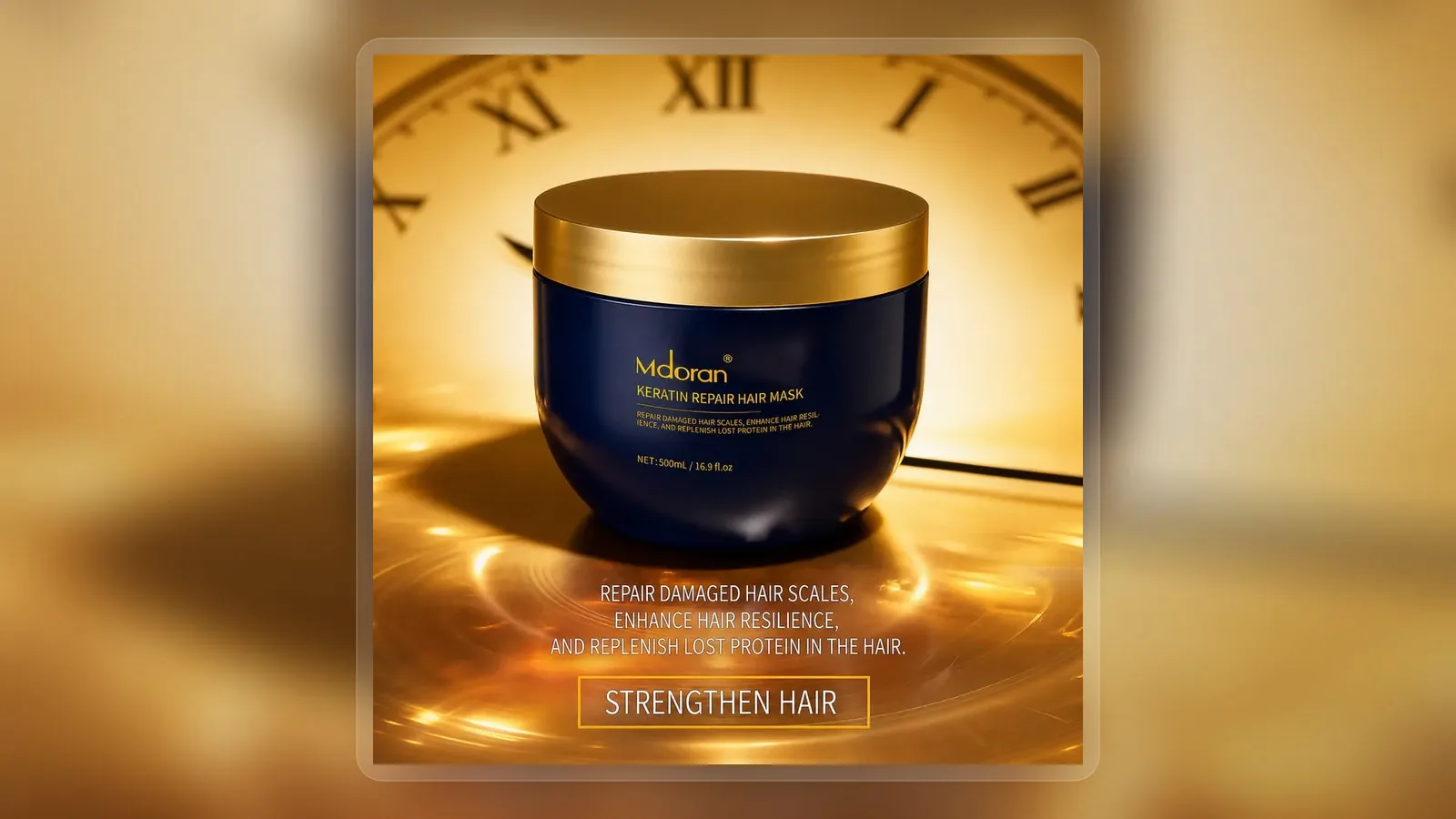
Hair Repair Architecture: How Shampoo, Mask, and Leave-In Build on Each Other
Quick answer: Shampoo, hair mask and leave-in treatment are not three versions of the same product at different strengths. They operate at three different stages of the hair care cycle and do three different jobs. Shampoo cleans the fibre and opens the cuticle. Mask penetrates and deposits conditioning agents that need time and warmth to bind. Leave-in forms a protective film that survives until the next wash. A line that skips a stage — or that loads all three with the same conditioning agents — produces diminishing returns, because the second and third products are working on surface that the first one already coated.
Most hair care ranges sold to salons and retailers are described by benefit: moisturising, repairing, strengthening, colour-protecting. Those labels are commercially useful but technically vague. Underneath them, any well-constructed range performs three distinct mechanical operations in sequence, and the products only work as a system if each one is built for its own stage.
This article explains what each stage does at the fibre level, why the same conditioning agent cannot serve all three, and how to evaluate whether a proposed range is actually architecturally coherent.
What actually happens to hair fibre
Hair is a layered structure. The outermost layer, the cuticle, is a set of overlapping scales. Beneath it lies the cortex, which contains the keratin structure and, in coloured hair, the pigment. At the centre of thicker fibres is the medulla.
The cuticle is the part that matters most for product design. When intact and lying flat, it is smooth and reflects light — this is what consumers perceive as shine. When raised or damaged, it catches on adjacent fibres, feels rough, and loses moisture rapidly. Almost every claim a hair care product makes ultimately reduces to what it does to the cuticle and how well it keeps the cortex's moisture content stable.
| Stage | Product | Primary action | Contact time | Carrier requirement |
|---|---|---|---|---|
| 1. Cleanse | Shampoo | Remove sebum, product residue and particulates; lift the cuticle slightly | 30–60 seconds | Surfactant system; rinse-off |
| 2. Treat | Hair mask / deep treatment | Deposit conditioning agents and humectants that need time to bind to the fibre | 5–20 minutes | Rich emulsion; rinse-off |
| 3. Protect | Hair protein treatment / leave-in | Form a film that reduces friction and slows moisture loss until the next wash | No rinse | Light cationic or film-forming system; must not build up |
Stage one: shampoo has to be harsh enough and gentle enough at once
The shampoo's job is removal. The design tension is that the same surfactant action that removes sebum and residue also strips the conditioning agents the previous wash deposited, and can lift the cuticle further than is ideal.
This is why a shampoo that is "too good" at cleaning produces a range that feels worse over time. If the shampoo removes everything, the mask has to work harder, and the leave-in has to compensate for the mask's shortfall. The consumer experiences a range that feels heavy, or one where hair becomes progressively drier despite regular treatment.
A well-designed shampoo for a treatment range is therefore deliberately balanced: sufficient cleansing power for the target scalp type, a surfactant blend chosen for mildness, and a small amount of conditioning or cationic component that begins the deposition work before the rinse. For a repairing range, shampoo is a setup product, not a standalone one.
Stage two: masks need time, warmth and molecular size
The mask is where deposition volume happens. Conditioning agents — cationic surfactants, fatty alcohols, oils and silicones — need contact time to associate with the negatively charged fibre surface and to diffuse into the cuticle layers.
Three properties govern how effective a mask actually is.
Contact time. Five minutes and twenty minutes produce measurably different deposition. This is why salon treatments specify a duration and often heat. A consumer product that is rinsed off after two minutes is not equivalent to a salon treatment with the same formula.
Molecular size. Larger conditioning molecules sit on the surface and give immediate slip and detangling. Smaller molecules can penetrate further into the cuticle and cortex, contributing to the longer-term feel claims. A mask that only contains large molecules will feel excellent on application and then revert, because nothing went below the surface.
Deposition efficiency. Not all of what is applied stays on the hair. Formulation determines the fraction that deposits versus the fraction that rinses away. Two masks with identical ingredient lists at identical percentages can have very different deposition efficiency if the emulsifier system or pH differs.
| Mask property | Immediate effect | Effect after rinse and dry |
|---|---|---|
| High surface conditioning | Strong slip, easy detangling | Soft but may feel coated; drops with repeated use |
| High penetration | Less dramatic initial slip | Improved feel that holds through the week |
| Balanced system | Good slip plus structure | Progressive improvement without build-up |
Stage three: leave-in has the longest duty cycle and the tightest constraints
Leave-in treatment is the hardest product in the range to formulate well, because it is the only one that stays on the hair for the entire period between washes — typically two to four days.
The requirement is a film that is protective enough to reduce friction and slow moisture loss, light enough that it does not make hair limp or greasy, and removable enough that it does not accumulate across repeated applications. Those three requirements pull against each other, and the balance point differs by hair type.
On fine hair, a film that is adequate on coarse hair will visibly weigh the fibre down within one application. On highly porous, colour-treated hair, a film light enough for fine hair will not control the moisture loss that porous hair experiences. This is the legitimate technical basis for selling leave-in products in more than one variant — and it is a more defensible reason than a marketing-driven tier structure.
The build-up problem
Build-up is the most common failure of a hair care range sold as a system, and it is almost always an architecture problem rather than a formula-quality problem.
It happens when stages two and three deposit the same class of agent. The mask leaves a film; the leave-in adds another layer of the same material; the next shampoo does not fully remove either because it was designed to be mild. Over a week or two, the cumulative film changes how the hair behaves — it loses body, becomes harder to style, and can appear duller because the surface no longer reflects light cleanly.
There are two standard solutions. The first is to distinguish the chemistry between stages: use penetrating and restructuring components in the mask, and film-forming or friction-reducing components in the leave-in, so the two layers are not additive in the same way. The second is to build a periodic clarifying step into the range, so that the consumer resets the surface rather than accumulating indefinitely.
| Symptom reported by consumers | Likely architectural cause |
|---|---|
| "My hair feels heavy after a few days" | Mask and leave-in depositing the same agent class; shampoo too mild to reset |
| "The mask works at first, then stops" | Surface-only conditioning; no penetrating component, so each application only replaces the previous film |
| "Hair is dry despite regular treatment" | Shampoo stripping more than the mask can replenish, or leave-in film too light for the porosity level |
| "Colour fades faster than expected" | Cuticle not kept closed; the mask lacks the components that smooth and seal the surface |
| "Fine hair goes limp immediately" | Leave-in weight calibrated for a coarser fibre type |
How to evaluate a proposed range
When a manufacturer presents a shampoo, mask and leave-in as a system, four questions separate a genuine range from three products that happen to share packaging.
- What is each product's primary deposited component, and are they the same? Identical principal conditioning agents across all three stages is a warning sign.
- Does the mask contain both surface and penetrating components? A mask with only large-molecule conditioning will feel good once and plateau.
- Is the leave-in weight specified against a hair type, or is one variant offered for everything? One variant for all hair types is a cost decision, not a technical one.
- Is there a clarifying or reset step, or a stated cycle for using one? Ranges designed without this accumulate film.
Summary
Shampoo cleans, mask deposits, leave-in protects. Each stage has a different contact time, a different carrier requirement and a different failure mode. Ranges succeed when the three stages are designed as a sequence with distinct chemistry, and fail when they are designed as three independent products with escalating richness. For buyers, the useful evaluation question is not which product is best, but whether the three products are doing three different jobs.
Frequently asked questions
Do I need all three products to make a complete range?
Not necessarily. A two-stage range — shampoo plus either a mask or a leave-in — can work well if the two products have clearly distinct roles. The failure case is a two-stage range where both stages do the same job.
How long should a mask be left on?
It depends on what the mask is designed to deposit and how much penetration is intended. Five minutes is typical for consumer use; salon treatments often specify longer contact and may apply heat. The specification should come from the formulation, not from convention.
Can a leave-in treatment replace a mask?
Not fully. A leave-in cannot deliver the deposition volume of a rinse-off mask with extended contact time. It can maintain and protect what the mask deposited, but it is a different operation.
Why does my repairing line seem to stop working after a few weeks?
The most likely cause is cumulative build-up from a mask and leave-in depositing the same agent class, combined with a shampoo that is too mild to reset the surface. Reviewing the deposited components of each stage is the first diagnostic step.
Should a colour-protecting range use different conditioning agents?
The conditioning architecture is broadly similar, but a colour-care range gives more weight to components that keep the cuticle smooth and closed, because an open cuticle releases pigment faster. The difference is prioritisation rather than a different category of ingredient.
Building a hair care range as a system? Bamilong develops shampoo, hair mask and hair protein treatment as coordinated ranges rather than standalone products, with formulation, sampling, packaging and production handled in one workflow. Send us your target hair types and benefit claims, and we will outline a stage structure that avoids build-up from the start.