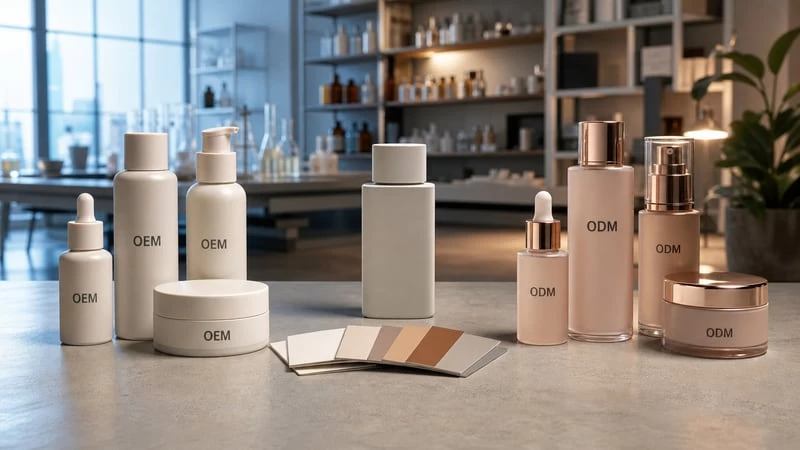
Quick answer: Choose OEM or ODM based on how much formula control, development work, differentiation, documentation, and launch responsibility your team can manage. The terms are used differently across suppliers, so the contract and project scope matter more than the acronym alone.
Clarify what the supplier means by OEM and ODM
One supplier may use OEM for any private-label project, while another uses it only for buyer-provided formulas. Ask for a written description of formula source, permitted changes, ownership, testing, packaging responsibility, and included services.
Do not assume that ODM means exclusive. A ready-developed base may be offered to multiple buyers unless exclusivity or territory terms are agreed in writing.
Cosmetics OEM vs. ODM decision matrix
| Question | OEM-leaning project | ODM-leaning project |
|---|---|---|
| Formula direction | Buyer supplies or tightly controls brief | Supplier presents developed options |
| Development load | More buyer decisions and review | Faster comparison of available bases |
| Differentiation | Potential for deeper customization | Usually focused on selected modifications |
| Documentation | Project scope must define ownership and access | Confirm what supports the selected base |
Commercial points to put in writing
- Formula source, allowed changes, and ownership or use rights
- Sample rounds and what triggers additional development work
- Packaging sourcing, molds, artwork, and component ownership
- Tests, specifications, documents, and responsible parties
- Project-specific MOQ, pricing assumptions, and change control

A practical selection workflow
- Define the product, channel, differentiation target, budget range, and launch timing.
- Ask suppliers to explain their OEM and ODM scope in writing.
- Compare formula control, package work, test scope, documentation, and commercial assumptions.
- Sample the complete product and record revisions.
- Sign off the final specification and responsibilities before production.
Buyer FAQ
Is ODM always faster than OEM?
It can reduce early formula development, but packaging, revisions, testing, artwork, and approvals still affect timing. Confirm the actual project path.
Does OEM mean the buyer owns the formula?
Not automatically. Ownership and use rights depend on the agreement and formula source. Put the terms in writing.
Can an ODM formula be customized?
Often to some degree, but the permitted changes and their impact on testing, MOQ, cost, and timing must be confirmed.
Which model suits a first launch?
The answer depends on the buyer’s differentiation needs, internal technical resources, budget, and schedule. Compare complete scopes rather than labels.
What should quotations separate?
Ask for formula or development charges, packaging, decoration, testing, freight assumptions, and any one-time costs as separate items.
Send a quote-ready project brief
For an OEM or ODM comparison, send the product type, formula control required, package and fill size, branding and decoration, target market, customization priorities, estimated order range, packing, destination country, and desired delivery window.